Building the Future of Pediatric Behavioral Health in Rhode Island
By: Care Transformation Collaborative of RI (CTC-RI) - Elizabeth Cantor, PhD; Nelly Burdette, PsyD, MA; Linda Cabral, MM; Patricia Flanagan, MD, FAAP; Elizabeth Lange, MD
“Behavioral health is not separate from children’s physical health; it is an essential part of their overall health.”

For more than a decade, Rhode Island has been demonstrating what is possible when pediatrics embraces behavioral health as an essential part of children's overall health. Long before the youth mental health crisis gained national attention, pediatric practices across the state recognized that emotional, behavioral, and developmental health are inseparable from physical health. Through collaborative efforts led by the Care Transformation Collaborative of Rhode Island (CTC-RI) and PCMH-Kids, Rhode Island has emerged as a leader in pediatric integrated behavioral health (IBH), developing innovative models that bring behavioral health services directly into pediatric primary care.
As communities across New England continue to grapple with rising rates of anxiety, depression, behavioral concerns, and social stressors among youth, Rhode Island’s experience offers valuable lessons about what works, what remains challenging, and where opportunities exist for the future. This progress did not happen due to a grant or pilot program. It was built through long-term partnerships among pediatric practices, health systems, payers, state agencies, and families who shared a common vision for improving children's health.
Why Pediatric Integrated Behavioral Health Matters
Children and adolescents frequently experience mental and behavioral health challenges, yet many never receive specialty mental health services. At the same time, most children visit their pediatrician at least annually, making primary care the most consistent and trusted point of contact for identifying concerns and connecting families to support.
Pediatricians are often the first professionals that families turn to when concerns arise about anxiety, depression, behavior, development, sleep, substance use, or family stress. However, pediatricians face significant barriers, including limited time with patients, workforce shortages, and insufficient access to behavioral health specialists in the community.
Integrated behavioral health addresses these challenges by embedding behavioral health professionals directly into pediatric practices. Rather than referring families elsewhere and hoping they connect with services, IBH is a team-based model where behavioral health clinicians, pediatricians, care coordinators, and other pediatric professionals work together to support children and families.
Establishing the Foundation
Rhode Island’s pediatric behavioral health transformation did not begin with behavioral health itself. The groundwork was laid through years of patient-centered medical home (PCMH) development, where CTC-RI/PCMH Kids helped practices develop coordinated, comprehensive, team-based care, including IBH. PCMH created the infrastructure that made behavioral health integration possible. Practices had already invested in team-based care, care management, quality improvement, and community partnerships, allowing behavioral health to become a natural extension of the care model rather than a separate initiative.
As pediatric practices strengthened care coordination, built partnerships with community organizations, and adopted quality improvement approaches, they became well-positioned to integrate behavioral health services. This foundation proved critical when CTC-RI/PCMH Kids launched its first pediatric integrated behavioral health initiative in 2019.
The initial IBH project supported pediatric practices in implementing core components of integrated care, including behavioral health screening, warm handoffs to onsite behavioral health clinicians, brief interventions, and referral pathways for higher levels of care. Participating practices represented a variety of settings, including community health centers, hospital-based clinics, and independent pediatric offices.
Expanding Beyond Traditional Models and Expanding the Care Team
While the clinical benefits of integrated behavioral health became increasingly clear, another reality emerged: traditional models are difficult to sustain financially. The COVID-19 pandemic further underscored the importance of integrated behavioral health, as pediatric practices experienced dramatic increases in anxiety, depression, trauma, and family stress while specialty behavioral health resources became increasingly difficult to access.
Rather than viewing financial limitations as a reason to stop innovating, CTC-RI and its partners began testing new workforce models that could expand access while improving sustainability. This included a model to pilot the placement of trained and supervised early career behavioral health clinicians into pediatric practices in partnership with the Foundation of Integrated Care.
The work also highlighted that behavioral health challenges rarely exist in isolation. Housing instability, food insecurity, transportation barriers, school concerns, and family stress often affect children's behavioral health as much as clinical symptoms themselves. This recognition led CTC-RI/PCMH Kids to expand integrated care teams by incorporating Community Health Workers into pediatric integrated behavioral health teams on various projects. CTC-RI/PCMH-Kids provided training and technical assistance to primary care team on how to leverage this new role. As part of an IBH team, CHWs can expand access to services by taking on activities such as family engagement, care coordination, and referral management. CHWs addressed behavioral health-related concerns and social needs challenges that prevented families from accessing needed services. Their involvement allowed behavioral health clinicians to focus more time on direct patient care while strengthening connections between families, the pediatric team, and community resources.
Key Successes
Integrated behavioral health improves access. Families can receive support in a familiar setting from providers they already know and trust, reducing barriers and stigma associated with seeking care.
Addressing behavioral health needs became part of routine pediatric care rather than something families sought only during crises.
Team-based models that include CHWs can reduce burden on clinicians. By distributing responsibilities across behavioral health clinicians, CHWs, and other team members, practices can respond more effectively to complex patient needs.
Practices developed greater competence and confidence managing mild-to-moderate behavioral health concerns while strengthening partnerships with specialty behavioral health providers for children needing more intensive services.
Through learning collaboratives, practice facilitation, and ECHO® programs, Rhode Island has created a culture of continuous improvement that allows practices to learn from one another and adopt best practices.
Ongoing Challenges
Despite substantial progress, important challenges remain. Financial sustainability continues to be one of the greatest barriers. Many integrated behavioral health activities, including screening, care coordination, consultation, and brief interventions, are not adequately supported through traditional fee-for-service payment models.
Workforce shortages also persist. Demand for pediatric behavioral health services exceeds the available supply of both community-based and integrated behavioral health clinicians. Pediatric workforce constraints further complicate implementation efforts.
In addition, many children require longer-term behavioral health services that extend beyond the scope of primary care-based interventions. Limited availability of specialty behavioral health providers can create bottlenecks and increase pressure on integrated care teams.
Looking Ahead
Rhode Island’s experience demonstrates that integrated behavioral health is no longer an optional enhancement to pediatric primary care, rather it is an essential component of high-quality care. No single organization can solve children's behavioral health needs alone. Continued success depends upon strong partnerships across primary care, schools, behavioral health providers, community organizations, and payers.
Future opportunities include expanding value-based payment models that support interdisciplinary care teams, including behavioral health clinicians and CHWs. Additionally, there is the need to strengthen behavioral health workforce development, enhance partnerships between schools and healthcare providers, and invest in innovative approaches that meet families where they are.
Perhaps Rhode Island's greatest lesson is that pediatric integrated behavioral health is not simply about embedding a behavioral health clinician within a practice. It is about redesigning pediatric care, so behavioral health is everyone's responsibility. That transformation requires sustained investment, strong partnerships, and a willingness to continually learn and adapt. While important challenges remain, Rhode Island's experience demonstrates that meaningful systems change is possible when organizations commit to a shared vision centered on children and families.
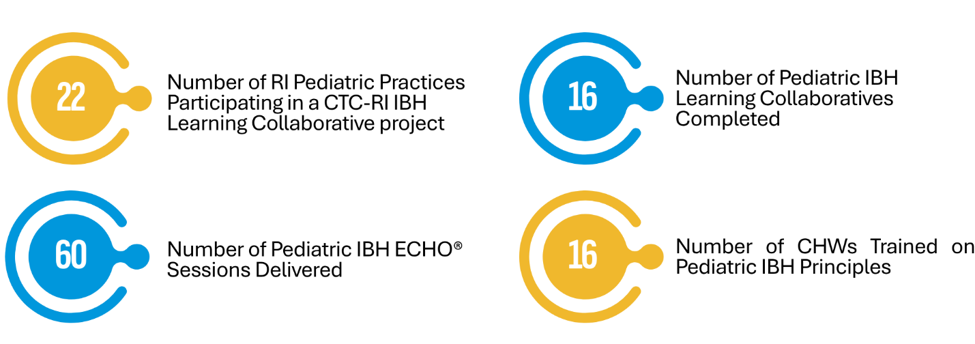
By the Numbers (See the image below)
———————————————————————————————————————————————————————
Interested in contributing to our blog? We welcome perspectives from researchers, clinicians, policymakers, advocates, and community members working to advance children's behavioral health. If you'd like to contribute to a future blog, please reach out to us at info@necbhn.org.