By Ellen Hallsworth, Director, BluePath Health
“Settlement dollars could seed durable infrastructure for children's behavioral health—from school-based services and mobile crisis capacity to workforce pipelines and prevention—or they could be absorbed into general budgets. The decisions made in 2027 will determine the difference.”

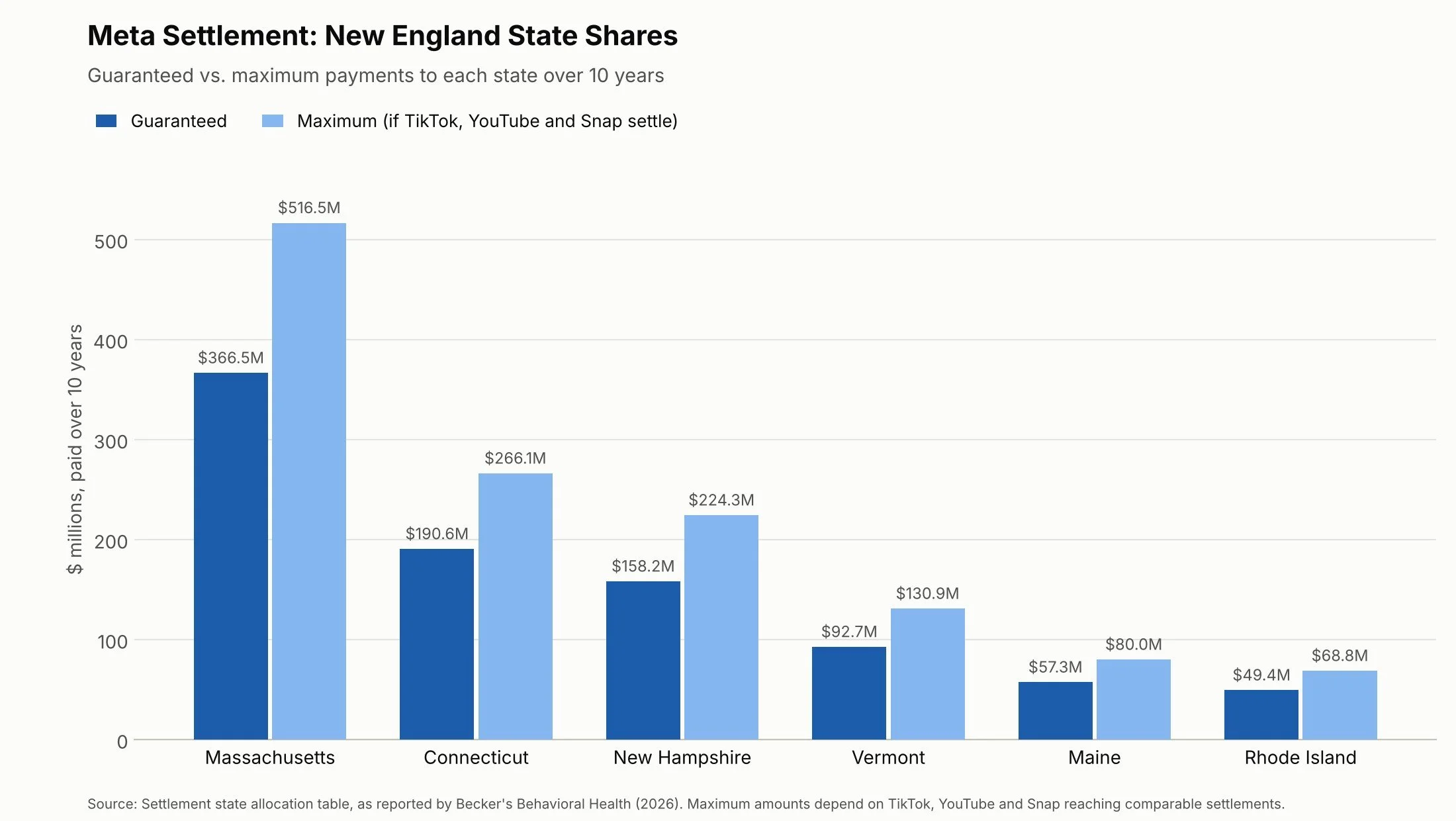
New England states are guaranteed roughly $900 million from Meta over the next decade, and could receive more than $1.2 billion. How much of it reaches children's behavioral health depends on decisions now landing in front of six state legislatures.
This is the second round of funding from a large legal settlement that states have received in recent years: funds from the opioid settlements started flowing in May 2022. How states are spending the money is often informed by their experience with opioid settlements, but also by current budgetary pressures in children’s behavioral health and elsewhere.
Read on to see what each state has said so far.
The National Picture
On August 26, 2026, Meta agreed to settle the multistate litigation alleging that Instagram and Facebook were deliberately designed to addict young users and that the company hid the risks. The deal cut short a federal trial in Oakland brought by California, Colorado, Kentucky and New Jersey, and resolved parallel cases filed by nearly every other state. U.S. District Judge Yvonne Gonzalez Rogers approved the settlement the same day. Only New Mexico, which had already won a $375 million jury verdict and a $567 million abatement award, and Florida, which declined to join, remain outside it.
The headline number needs unpacking. Meta must pay states $12.19 billion over ten years. That total rises to $17.1 billion only if TikTok, YouTube and Snapchat agree to comparable safety terms and payments. In practice, roughly 70 percent of each state's share is guaranteed, and the remaining 30 percent depends on what happens with those other platforms.
The settlement also changes the product itself. For users ages 13 to 17, Meta must impose a combined two-hour daily limit, block overnight access from midnight to 6 a.m., stop push notifications during the school day, strengthen age assurance, let parents turn off algorithmic feeds, and limit beauty filters and visible "like" counts. An independent auditor will assess compliance.
Substantively, the settlement names youth-serving uses for the money: crisis intervention and mental health services, after-school, summer and outdoor programs, digital wellness and literacy, phone-free schools, and provider training. It does not, however, guarantee that any state's share goes there. State leaders have discretion.
Right now, children’s behavioral health advocates are making the case for focused, ringfenced spending.
Here is where things stand in each New England state:
Connecticut
Connecticut will receive up to $265.4 million, with a floor reported at about $190 million. Connecticut is the only New England state that has publicly committed to a minimum spending share: at least half of the funds must go to remediating youth harms from social media. Mental health and crisis interventions have been named as priorities, as have after-school and summer programming.
Attorney General William Tong's office also led the multistate investigation into Meta's sharing of user data with Cambridge Analytica, which this settlement resolves. The settlement lands in a state already active on youth online safety: Governor Lamont recently signed the CART Act, which addresses youth online safety and high-risk AI applications.
Maine
Maine will receive no less than $56 million, the smallest guaranteed share in the region. The state’s Attorney General Aaron Frey was one of the original 2023 plaintiffs, and Governor Janet Mills welcomed the settlement as a first step while noting there is still much more to do. Neither office has yet described how the money will be allocated or who will decide.
Reporting by The Maine Monitor found limited public information on how the Attorney General's share of opioid settlement funds was being spent.Unless the approach changes, funding decisions around the Meta settlement may be similarly opaque.
Massachusetts
Massachusetts is guaranteed approximately $366 million over ten years and could receive up to $516 million. Massachusetts is the largest New England state in terms of population, and this is also the largest settlement in the region.
Attorney General Andrea Campbell has said the funds will go toward expanding youth crisis intervention and mental health services, after-school and outdoor programs, and phone-free school initiatives. Most starkly among New England officials, Campbell has framed the settlement's product protections as a floor rather than a ceiling, and urged the Legislature to pass a bell-to-bell school cellphone ban. Legislative leaders have signaled that they will pursue permanent standards beyond the settlement's five-year time-limit commitment.
New Hampshire
New Hampshire will receive up to $224.3 million, with about $158 million guaranteed. Unlike most states, New Hampshire pursued its own case in state court, which was set for trial in January 2027, and Attorney General John Formella credited that independent litigation for the size of the state's share.
Formella has said most of the money will likely go to youth mental health programs, but that it is too early for specifics. Advocates are already organizing. New Futures has urged that the funds go to children's behavioral health, noting that the share of high schoolers reporting poor mental health fell from 36 percent in 2021 to 26 percent in 2025, while rural families still face long waits for care. The Fund IRL New Hampshire coalition, coordinated by the New Hampshire Afterschool Network, has met with the Attorney General's office to advocate for ringfenced funding.
Rhode Island
Rhode Island will receive at least $49.4 million and up to $64.5 million. Rhode Island was a party to the settlement but not one of the states involved in the underlying lawsuit. Attorney General Peter Neronha has said the funds will be used to improve youth mental health services, though the funding will go to the state’s general fund. The decision-making process and any earmarks have not been spelled out. RI Kids’ Count and other advocacy groups are making the case for a focus on mental health access and after-school programming.
Vermont
Vermont will receive $92.7 million in annual installments of about $8.8 million, and up to roughly $127 million if the contingent payments come through. This makes it the largest single-company settlement in state history. The payments will flow into a special fund controlled by the Legislature, and Attorney General Charity Clark has said her office will advise but defer to lawmakers on spending. Competing ideas are already surfacing: one legislator has proposed using a portion to build a digital privacy and consumer protection division in the AG's office. Meanwhile, Clark's office held public hearings in September on a proposed rule to protect children online.
———————————————————————————————————————————————————————
Interested in contributing to our blog? We welcome perspectives from researchers, clinicians, policymakers, advocates, and community members working to advance children's behavioral health. If you'd like to contribute to a future blog, please reach out to us at info@necbhn.org.