By Sue Carroll Duffy, Psy.D. RPT-S™, Wabanaki Public Health and Wellness/Moving Stories
“Population play therapy expands the therapeutic powers of play beyond the therapy room, equipping families, schools, and communities with the skills to connect, guide, understand, and support children”
How do child-serving therapists and agencies respond to the overwhelming youth mental health needs that are not only a crisis in federally underserved areas, but a national crisis?
The American Psychological Association (APA) calls on psychologists to take a “population health” approach that works collaboratively across different disciplines. “Population health” includes traditional healthcare systems and expands beyond them. This expanded approach describes my work as a play therapist in Maine where for many years, I have enjoyed what I will call “population play therapy”.
In “population play therapy” the play therapist expands the therapeutic powers of play and play therapy into settings and programs that reach and teach in communities and schools. This way, more people learn core play therapy skills to connect, guide and deeply understand and support children wherever they are—in their families, community or in school.
There are not enough licensed clinicians to meet the demand for care by serving children and families in one-to-one sessions, especially in remote and tribal communities. Population play therapy gives us another tool for doing this, and a way of integrating therapeutic experiences with storytelling and culture.
Population Play Therapy in Community
Wabanaki Public Health and Wellness (WPHW), is a tribal public health organization that serves communities in Maine. For WPHW, healing is connected to an awareness of historical trauma and an emphasis on culture, language and traditional community healing practices. WPHW takes a two-eyed seeing approach where both traditional practices and adapted western practices are valued. Research is approached the same way.
Wellness and Connection Camp is a new program designed to bring tribal families from across Maine together to heal from challenges such as separations related to substance misuse. Inspired by the Celebrating Families program adapted for native communities with the White Bison curriculum, Wellness and Connection Camp takes place in the summer once a week for eight weeks.
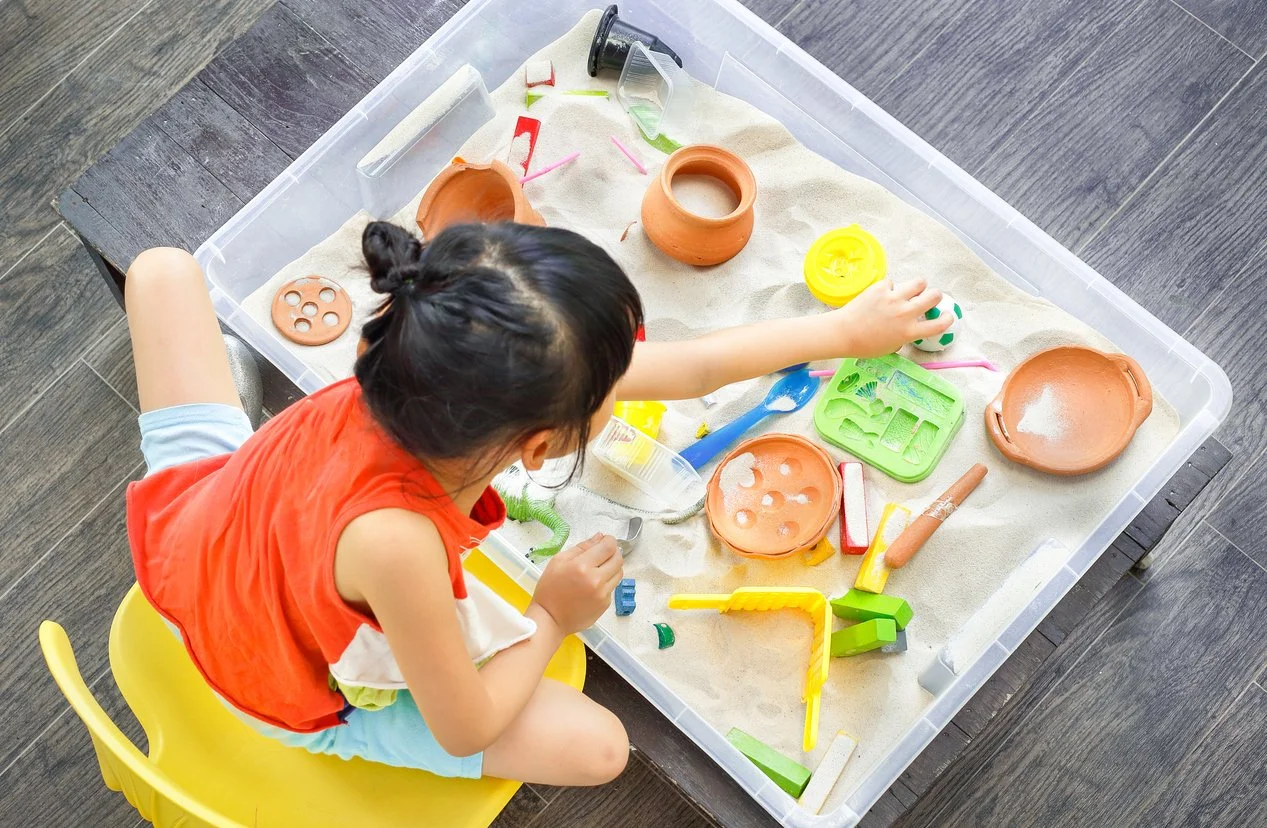
In preparation for camp, child serving staff, clinicians and interns learn the Moving Stories play therapy method. Moving Stories is a play therapy tool that I developed over the last 20 years. Stories are told using objects in the theater of a sandtray followed by group reflection and an opportunity for creative expression where individuals and groups are deeply heard. Together with tribal interns we adapt the Moving Stories play therapy method by using cultural stories told by tribal members in the sandtray to teach educational and healing themes each week.
Bringing tribal families together in a culture-based program has been a profound experience for staff and families alike. The expansive “population play therapy” approach extends play therapy skills to diverse child-serving staff and families.
Population Play Therapy in Schools
Transforming Rural Education Experience (TREE) is another inspiring program that approaches the needs of youth from a population perspective. In this multi-year research-practitioner model, play therapists work in schools. The Moving Stories play therapy method was the Social Emotional Learning (SEL) program. TREE trained teachers, trauma coaches, counselors and play therapists to tell stories in the sandtray. They created a library of Moving Stories kits for staff to use. The stories introduced the theme, and then the group process provided practice in social emotional skills such as making friends, sharing and developing safety in the classroom.
The book Trauma Responsive Schooling: Centering Student Voice and Healing by Lyn Mikel Brown, Catharine Biddle, and Mark Tappan describes the impact of the program in two rural schools. They found that onsite play therapists, Moving Stories for social and emotional learning, school trauma coaches, outdoor adventures and a range of other student-led programming and supports, resulted in improved test scores, attendance and student engagement.
In one remote tribal school, in the last year, a tribal member and social worker became the principal. She is also trained as a play therapist. Under her leadership, over the past couple of years the therapeutic powers of play are available across the school. There is a beautiful room, the “Eagle’s Nest”, where children are invited to go when they need emotional support. This room has sensory items, calming colors and lights, games, a sandtray and objects. Interested staff are invited to learn more about ways to support children with storytelling in the sand. Embedding play in schools provides safe ways for children to express feelings safely, particularly during times of community crisis.
Population Play Therapy and Youth Mental Health Needs
Our work in this chronically underserved region of Maine demonstrates the concept of “population play therapy” to meet the needs of youth. By playing together, we can grow from one-on-one session, to community settings where play therapy skills are shared, and shared again.
Find out more about play therapy through the New England Association for Play Therapy.
———————————————————————————————————————————————————————
Interested in contributing to our blog? We welcome perspectives from researchers, clinicians, policymakers, advocates, and community members working to advance children's behavioral health. If you'd like to contribute to a future blog, please reach out to us at info@necbhn.org.